Hanging / 1450 mm
Eye level is a decision
The convention puts the centre of a work at roughly 1450mm — an average standing eye height. It is a working default, not a rule, and moving away from it changes the psychological register of everything on the wall.
In this entry
- The origin of the number
- What changes when you move the centre
- The room as a variable
- Deciding deliberately
The origin of the number
Fourteen hundred and fifty millimetres sounds precise. It isn't, quite. It is an approximation — a mid-point derived from population height data that places the average standing eye height of an adult somewhere between 1430mm and 1470mm, depending on which sample you use. Most galleries and museums have settled on a figure in that band, often citing 57 or 58 inches if they work in imperial, which lands in the same zone. The Smithsonian's facilities standards, to take one published example, use 60 inches (roughly 1524mm) to the centre of a work — slightly higher, reflecting a building with wide-open galleries designed for unhurried movement.
The point is not which number is correct. The point is that the number is a decision about a body. You are choosing whose eyes meet the centre of the work, and under what conditions — standing, moving, alone in a large room or pressed against a neighbouring visitor in a crowded one. Every institutional guide that publishes a preferred hanging height is making an anthropometric argument, whether its authors think of it that way or not.
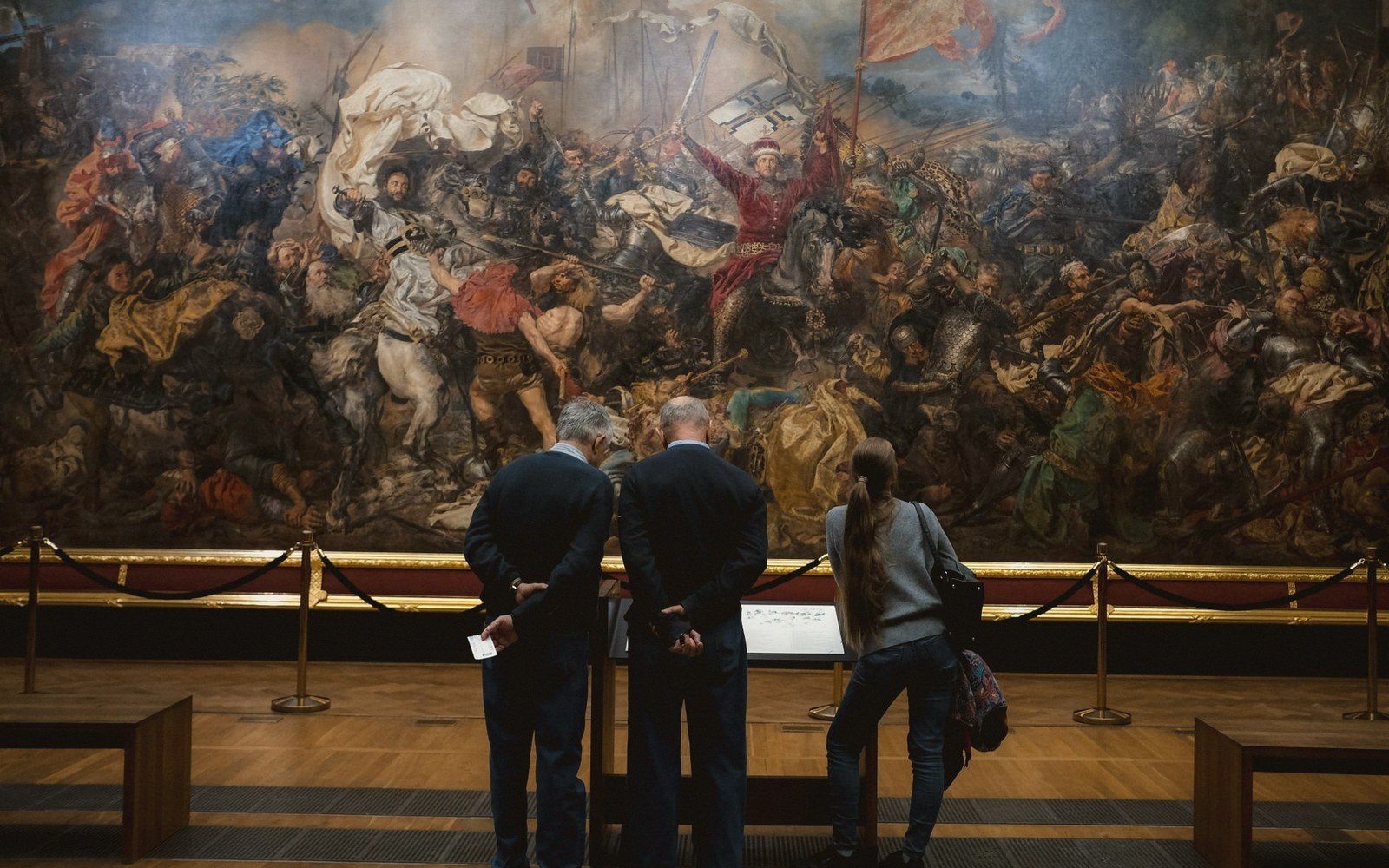
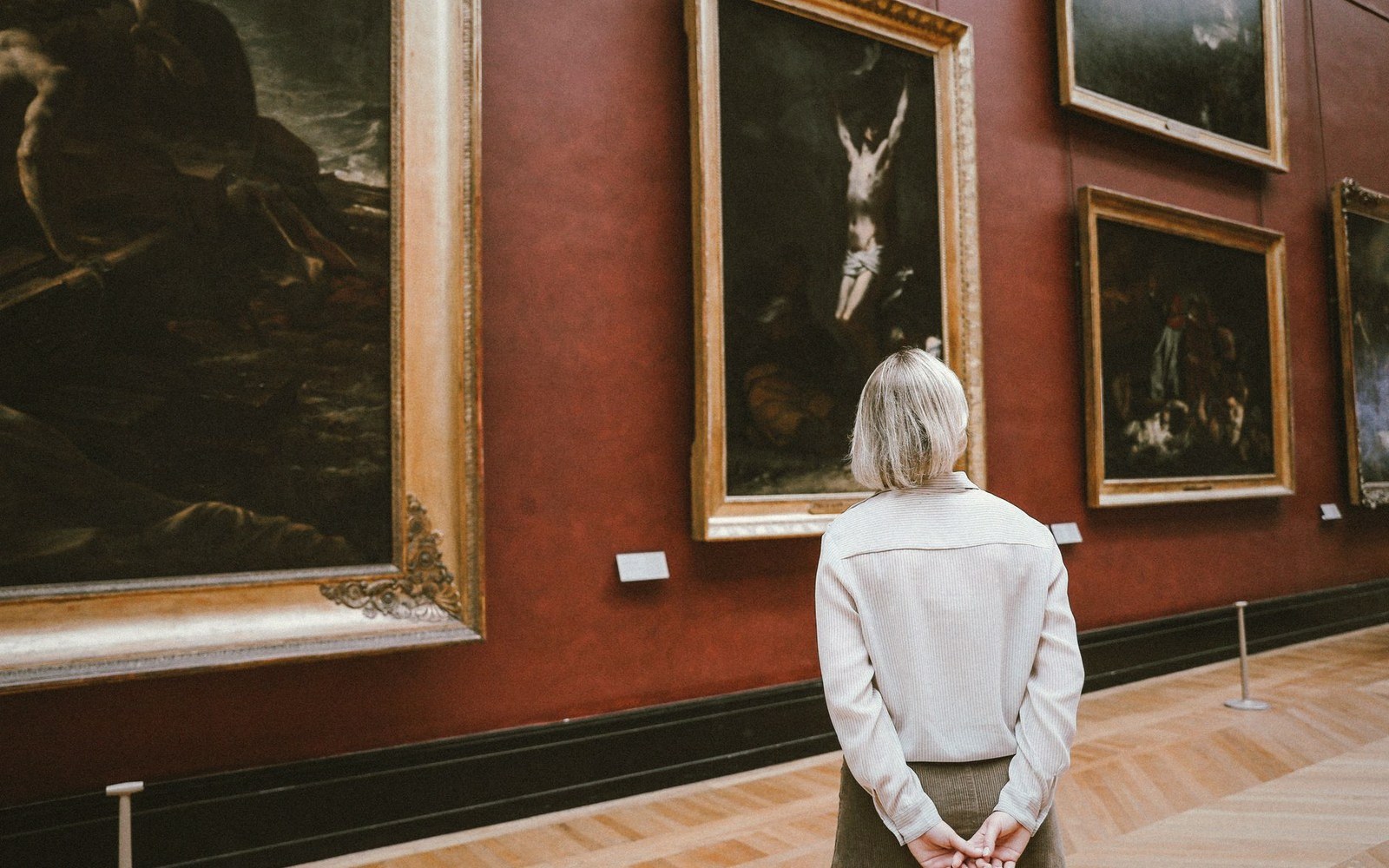
The convention also has a history. The floor-to-ceiling density of a nineteenth-century salon wall placed works at many heights simultaneously, organised by genre and hierarchy rather than by any single viewer's eye line. The modernist shift to sparse, eye-level hanging — associated with the white cube aesthetic that crystallised in the mid-twentieth century — was a deliberate repositioning of the viewer as the primary reference point. The gallery became a room scaled to a standing body rather than to an architectural wall.
What changes when you move the centre
Raise the centre height and you introduce looking up. This is not simply a physical adjustment; it shifts the psychological weight of the exchange. Portraits hung high look down on you. Large figurative works acquire a different authority — they survey rather than meet. In a domestic hall or staircase, this is often correct: the work fills the vertical field of movement, seen briefly and at a distance, and a low hang would look as though it had slipped. The height compensates for the diagonal sightline of someone ascending or descending stairs, where true eye level is a moving target.
Lower the centre and the opposite happens. You lean in. The work assumes the register of something private, something placed for contemplation at close quarters rather than recognition at a distance. A small cabinet painting set at 1450mm centre in a large room can disappear into the wall; the same work at 1200mm, in a chair-height position, recovers its intimacy. This is why the small work often demands its own approach — it was made to be seen close and low, and the standard hanging height serves it poorly.
Seated rooms follow their own logic entirely. A library, a waiting room, a domestic sitting room where people spend long periods at rest shifts the relevant eye height down to roughly 1150–1200mm. Hanging at standing eye level in that context creates a mild but persistent discomfort — the viewer must tilt their head back, the neck tenses, and the relationship becomes subtly effortful rather than natural. Works hung for seated viewing should have their centres dropped accordingly, even if the result looks low to someone walking in.
The room as a variable
None of this operates in isolation. Centre height interacts with everything else: the depth of the room, the height of the ceiling, the tone of the wall, the size of the works themselves. A 2.5-metre ceiling and a small work hung at 1450mm centre can feel well-proportioned; the same work at the same height under a 4.5-metre ceiling floats in dead space, anchored to nothing, small in a way the work itself does not intend. Tall rooms sometimes call for a higher hang simply to hold the wall together visually, even if that means the viewer looks slightly up. The eye adjusts to the room before it adjusts to the work.
The sightline from the door is also a condition. What a visitor sees first — and at what height — determines the terms of entry. A work centred at standing eye level in the direct line of the doorway reads as a frontal address. The same work shifted up or down even 150mm changes that encounter, making it slightly more monumental or slightly more intimate before the viewer has consciously registered the difference. These are fine calibrations, but rooms that work tend to have been calibrated, even intuitively.
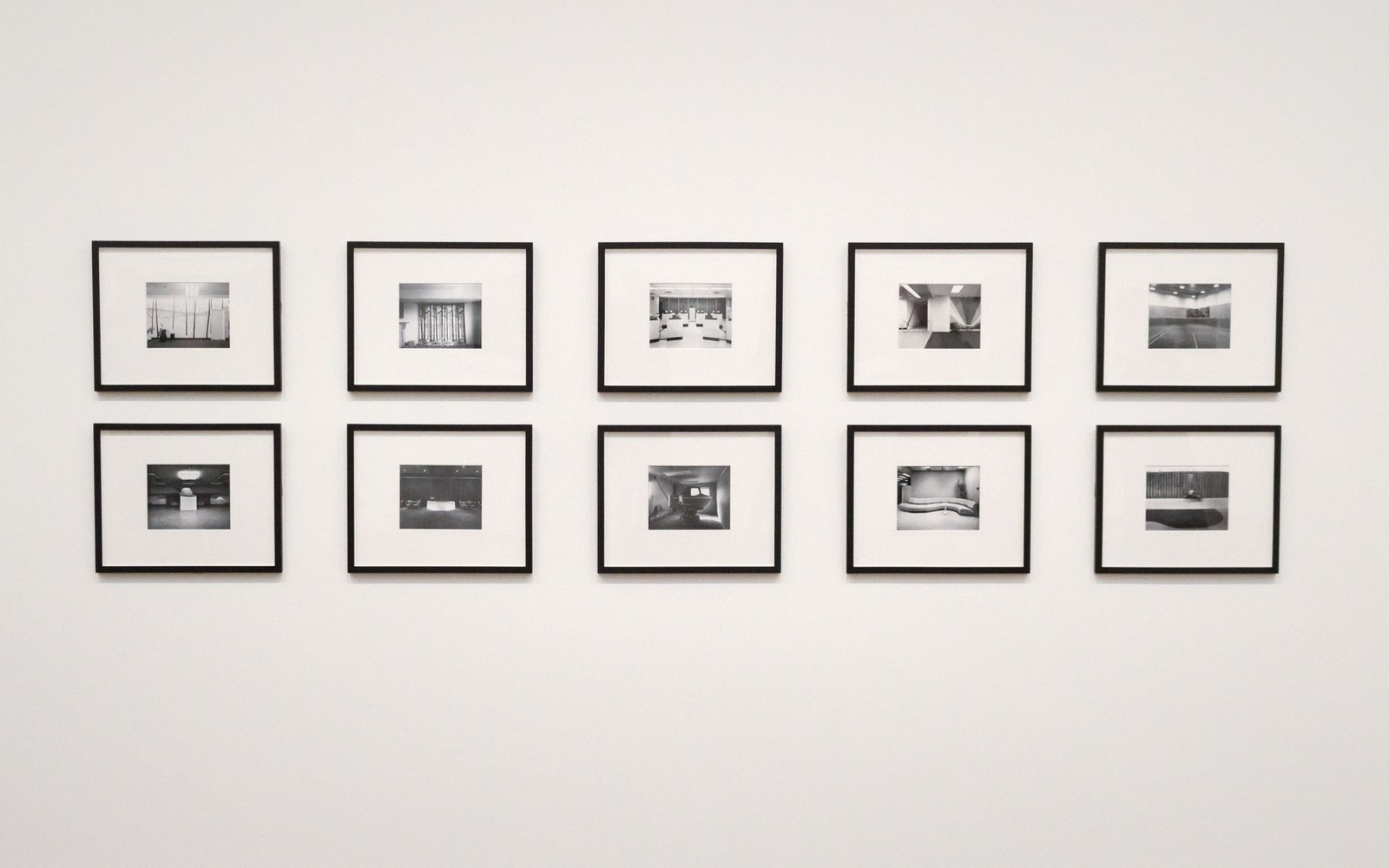
Lighting compounds all of this. A picture light or a track fixture aimed at the centre of a work is set for a specific hanging height; change the height and the beam angle shifts relative to the surface. A work moved 200mm down may end up with the hotspot hitting its upper third rather than its centre, creating uneven illumination that was not there before. This is a practical reason, beyond aesthetics, to decide on centre heights before finalising the lighting rig, not after.
Deciding deliberately
The value of treating 1450mm as a default rather than a rule is that it forces a question: who is this work for, and how are they encountering it? A work made to be seen from across a room — a large history painting, a tonal landscape — may want a higher centre to place it properly in the far-distance reading it was designed for. A work made to be examined — a miniature, a highly worked drawing, a photograph dense with detail — wants to be at or below eye level and close enough for the detail to be legible.
The worst outcome is a hang that has not asked the question at all: everything set at 1450mm centre by default, regardless of work size, room proportion or viewing condition, because that is what the tape measure says. A room hung with uniform centre heights regardless of scale will look orderly on paper and lifeless in practice — the work is being accommodated rather than presented.
The decision tree
- Standing gallery, unhurried circulation1450–1470mm centre, adjusted for ceiling height
- Seated or low-seating roomsdrop to 1150–1200mm
- Staircase or hallraise to account for diagonal sightline
- Large work in a tall roomraise centre to hold the wall; viewer looks slightly up
- Small intimate worklower centre to recover the close, private register the scale implies
Eye level is where the work meets the viewer. Setting it is the first act of interpretation in the room.
Also in Hanging