The Room / circulation
The Space Between
Where people stop is not random — the room's geometry decides it before anyone walks in.
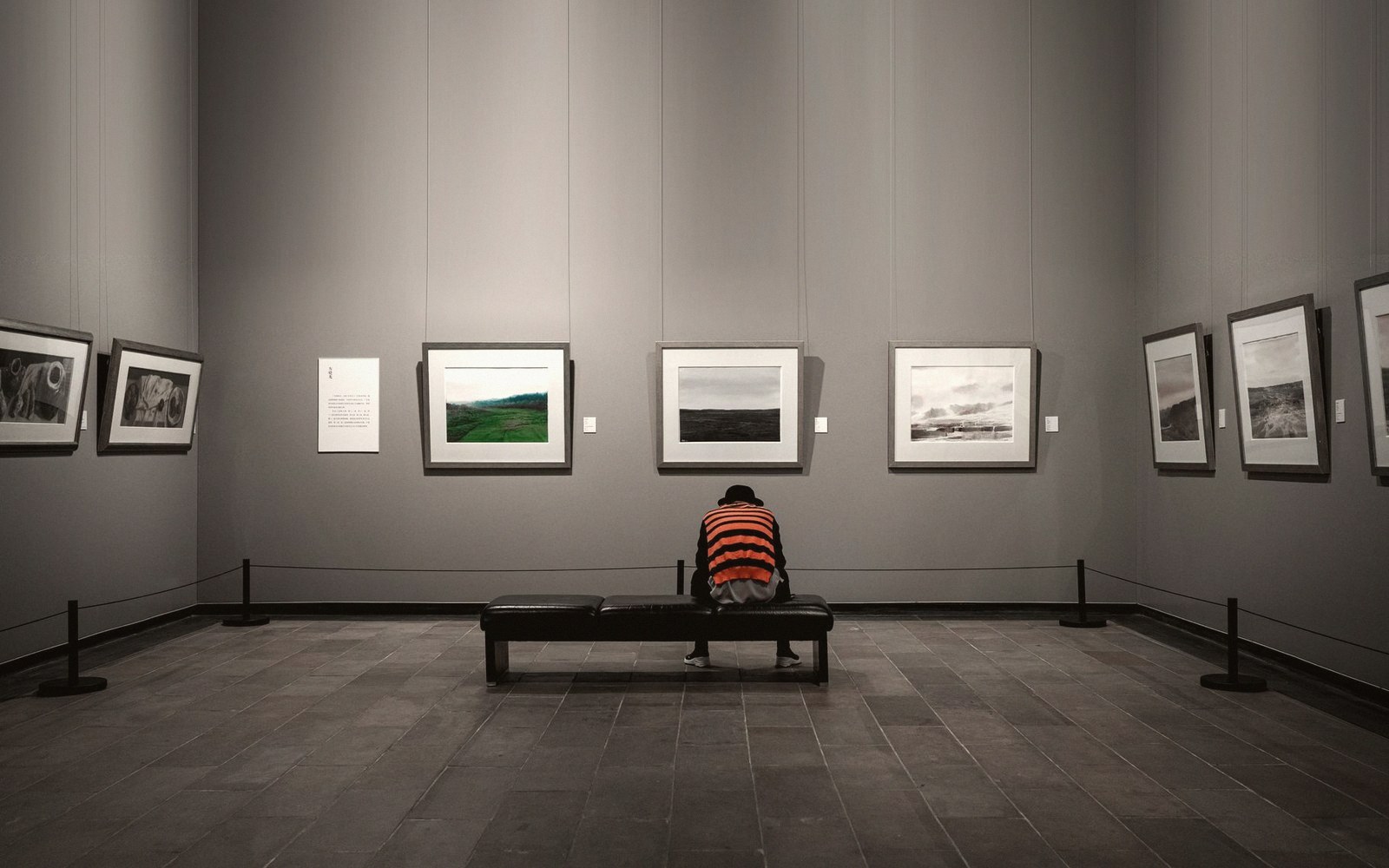
The Room Before the Art
Hang a painting at the correct centre height, light it well, frame it properly — and then put a bench in front of it. People will sit on the bench. They will look at the painting from exactly where the bench is, not from whatever distance the work needs. Circulation and seating are not afterthoughts to the hang; they are the hang, resolved in three dimensions.
The room shapes where people pause whether the designer intends it or not. A doorway creates a natural stop: the visitor hesitates on the threshold, takes in the sightline, then moves. A constriction in the corridor pushes them to one side and they glance at whatever is hung there. A wide open floor with nothing to interrupt it keeps them moving — nobody stops in the middle of a thoroughfare. The furniture, or the absence of it, does the same work as the geometry.

Seating is frequently placed for the room's convenience rather than the work's. A bench centred in a gallery square reads as a gesture toward the visitor's comfort; whether it positions a viewer at the right distance for any of the paintings around it is rarely tested. For a large canvas that needs eight or ten feet to resolve, a bench at four feet is worse than no bench at all — it trains the eye to the wrong scale, and most visitors will not get up and back away. They will simply decide the painting is difficult.
Circulation paths matter in a different way. If the natural walk through a room passes a work at ninety degrees — close, fast, in passing — that work will be experienced as a glimpse regardless of its quality. The hanging position might be formally correct but functionally dead. Where the path bends, where it widens, where it dead-ends: these are the locations that give a work time. Dead-end alcoves are undervalued precisely because they are off the main route; a viewer who enters one has chosen to, and will stay longer.
The room also decides density of attention. Too much floor space between works, with no reason to pause, produces a restless walk. Too little, and the room feels like storage. What reads as natural stopping distance — not too close, not exposed in open ground — is roughly the same measure that governs comfortable conversation: somewhere between arm's length and the point where you have to raise your voice. The room is always making that social calculation, even when nobody has thought it through.
Also in The Room